Let’s Catch Up!
Since my last post, my Study Abroad group and I have spent time bonding at retreat and researching different industries that we will get to learn about and interact with in Peru! Every day the anticipation builds, and I am just so ready to get going! But to bide the time, I want to share what my group has been up to!
Group Retreat: Challenge Course at Lake Laurel
Leading up to this retreat, I really had no idea what to expect. I was unaware that Georgia College had a challenge course like this, so imagine my surprise when I walked up and saw this crazy looking tower with climbing aspects and ropes dangling off it. I had no idea what I was in for!
I am not the most athletic person in the group, so I was very nervous I wouldn’t be able to complete any of the challenges (or make a fool out of myself in front of everyone). I had one goal going into it: make it to the top of at least ONE challenge. I started with the easiest looking course, the climbing wall. I watched a few of my groupmates before I worked up the courage to try it out myself. About halfway I started to get a little nervous about my abilities, but before I knew it, I had made it to the top! It was AWESOME! I realized I liked the challenge the tower presented, so I tried a couple more obstacles and thoroughly enjoyed each one.
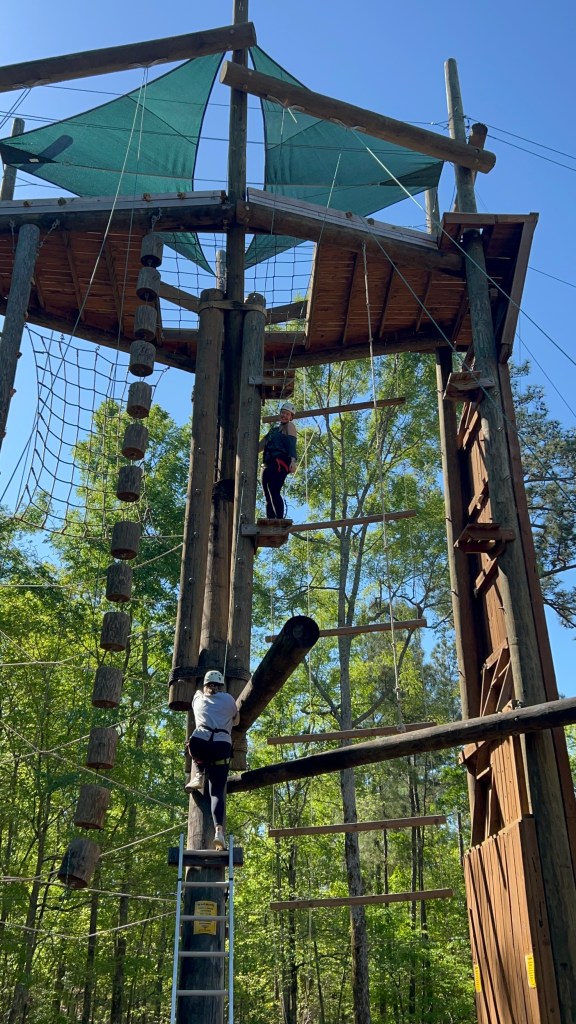
Everyone say hi to the fearless Maeve!
Activity Takeaways
It was so much fun getting to do this experience with my groupmates. I felt like I got to know each one a little better, and that our group was really starting to bond! It was really interesting to see everyone’s different personalities come out, and how they respond to different environments like the different challenges on the tower. Some of us dove in head first, some of us took a step back. But not once did anyone get pressured into something. The entire time I was on the tower, I felt confident and encouraged!
I think it was a good activity to get us in the right headspace for being abroad. Traveling can sometimes feel like that tower, being in an unknown place, looking at something foreign and not completely understanding it, and feeling like you are out of your element. But the good thing about this trip is that we are not facing these challenges alone! We can lean on each other and know that we have a support system there going through the same thing. We can jump in, or take a small step back, together!
Final In-Person Class
While watching everyone’s final presentations, it was crazy how many of them connected to each other! We had such a wide variety of topics, I had no idea what to expect from any one of them. It was really interesting to see which industries had the most connections, and the ways they impacted others.
Ava was the one to kick us off for the night. She taught us more about the specific environmental stressors that affect Peru. With a solid one-third of the country’s population living in urban areas, they have issues managing waste and air pollution. But the stressors affecting the rural and natural areas are even more dangerous. Things like deforestation, mining, and various climate change factors are putting immense pressure on Peru’s landscape. Natural habitats for plants and animals are being put in jeopardy, and indigenous groups are being constantly disrupted. Everything and everyone in Peru depends on the land, but sometimes it is taken advantage of.
Continuing on some of those lines, Will talked about the corporate accountability to mitigate some of those stressors with ESG Reporting guidelines. He explained that ESG requirements vary vastly from country to country, and most are actually optional. However, there are groups like the Ministry of Environment and Peru Sostenible that aim to educate business owners in their duty of care to the environment and their customers. Will also talked about Peru’s 2030 plan, and that their main goal is to keep refining ESG requirements and emphasize environmental sustainability in the corporate industries.
Watson shared an interesting topic talking about the waste infrastructure gap that Peru faces. The country generates 21,600 tons of waste daily with only about 65 formal garbage dumps. While the people who reside in urban areas have better access to these disposal sites and public sewage, a very small percentage living in rural areas have the same privilege. This leads to illegal and unregulated dumps, which in turn have negative impacts on the environment and surrounding communities. It is hard for the country’s government to combat these issues, but luckily some companies are finding ways to do it themselves. The lodges along Lake Sandoval use biodigesters to treat their sewage and keep it from polluting the water!
Presentation Takeaways
Hearing from all my group mates really broadened my foundational knowledge of sustainability and how it looks across the world. Peru is a beautiful and nature rich country, so that automatically puts it at a high risk. It is important to be able to recognize the damage done and the need for change. However, it can be hard to understand the scope of the impact when it is a topic not stressed by governments or mainstream corporations. The idea of tackling these pressures can seem overwhelming and even daunting, but it is a challenge we must commit to for the sake of our future generations.
My Presentation
I was able to present on a topic near and dear to my heart, farming! And what better country to look into than Peru? I was able to share all about the history, geography, economic importance, and sustainability challenges of agriculture that Peruvians face. Farming has long been deeply rooted in the Inca empire, and they had to learn how to master the different (and extremely difficult) landscapes: the Sierra (mountains), Selva (forest), and Coasta (coast). Each one has its own benefits and challenges. The Andes face rapid glacier retreat, which in turn makes the river valleys dry up. The Amazon has increased encroachment and deforestation, and the coast sees rapid temperature changes during El Nino years. However, there are some practices that help small and large scale farms combat these challenges. Combining original Inca techniques with new technology and information, Peruvian farms boost agricultural exports and contribute to over $10 billion in revenue every year.
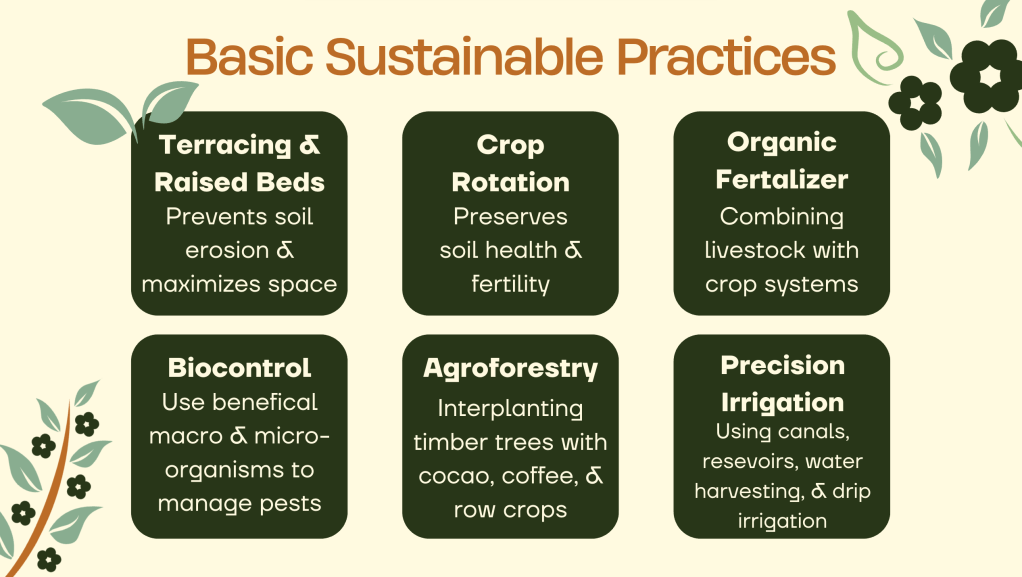
Above is a snapshot from my presentation discussing some of the different techniques used by Peruvian farmers to combat climate pressures in agriculture.
Being able to dive deeper into Peru’s agricultural sector has given me an even greater appreciation for the practices that go in place to make such a staple industry support not only their own, but other global economies. I know the real time issues Peru faces, and understand they are probably tenfold in other places. I look forward to being on the ground and seeing for my own eyes the people who are working to make changes for their environment. I can only hope that this trip allows me to do the same for the people who come after me.
Departure is Approaching SOON!
We only have about 6 weeks until we leave and every day the anticipation grows! Right now, all I am really worried about is what to pack (your girl here is a chronic overpacker). I am just so excited to actually set my feet on the ground and see what Professor El-J has in store for us! I spoke in my last post about all the places I am excited to visit, but I am now getting excited to see what I get to learn and the people I get to meet! The sky is truly the limit for this trip, and I just can’t wait to see how it impacts all of us!
More to come, until then… hasta luego, and cuídate! (I’m working on my conversational Spanish so don’t judge too hard!)
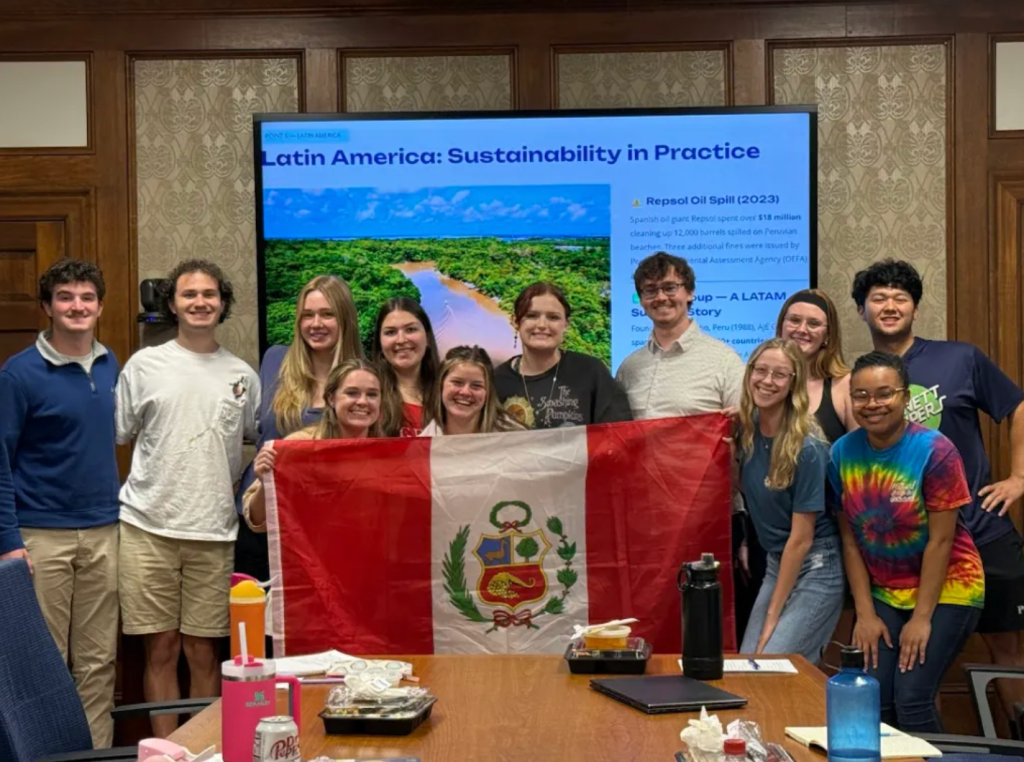
 Sarah K in Peru!
Leave a comment